The Three-Hole Diagnosis: Calibrating a Round Before the Fourth Tee
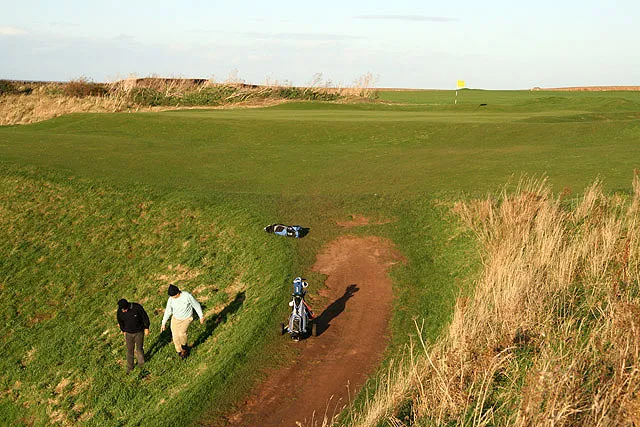
Photo: Walter Baxter, CC BY-SA 2.0, via Wikimedia Commons
The first three holes of an unfamiliar course are often treated as a formality: a stretch to loosen the shoulders, find the clubface and settle the nerves. That is a mistake. On any serious layout, and particularly on a Montgomerie-style course, the opening trio is a diagnostic. It tells the observant golfer how wide the fairways really are, how the bunkers are meant to be read, what kind of green complexes will dominate the day and whether the wind will be a passing inconvenience or a permanent negotiating partner. The fourth tee is the natural point at which to stop merely playing and start calibrating.
The First Hole: Width, Line and the Tee Shot You Actually Have
The opening hole is rarely the hardest, but it is usually the most honest. Stand on the tee and look beyond the flag. Is the fairway generous at your landing distance, or does it pinch exactly where your driver carries? Are the fairway bunkers positioned to be carried, avoided or simply admired? On many Montgomerie-designed layouts, the first fairway appears broad from the tee but narrows sharply at the distance a stronger player reaches. That visual trick is not deceit; it is a request. The course is asking whether you will choose a club that fits the landing zone rather than the ego.
Use the first hole to answer three questions. First, what is the real width at your likely driving distance, not at the widest point visible from the tee? Second, which side of the fairway offers the better angle into the green, and is that side protected? Third, does the rough punish a modest miss or merely cosset it? If the first fairway is wide but the green is angled, favour position over power. If it is tight from the outset, reduce the tee shot to a club you can find repeatedly. The adjustment may be as simple as moving from driver to three-wood, or from three-wood to a long iron, before the second hole rather than after the fifth.
The Second Hole: Bunkering as a Language
Bunkers are the most articulate features on a golf course. They do not simply punish; they speak. The second hole is often where a course reveals its bunkering grammar: whether sand is placed to be carried, to frame a dog-leg, to squeeze a favoured line or to intimidate a golfer into a weaker club. Note the faces. Are they shallow and playable, or deep and steep enough to demand a genuine escape? Are the bunkers set at driving distance or closer to the green? A cluster of cross-bunkers short of the green may be asking for a longer approach than you would otherwise choose; a single bunker on the inside of a dog-leg may be inviting you to start the ball on a braver line.
On Montgomerie-style courses, bunkering often creates a clear preferred route without making the alternative impossible. The club golfer should read that route on the second hole and decide whether it is worth taking. If the bunkers demand a carry you cannot reliably make, the correct adjustment is not a heroic swing but a different target. Aim at the safe side, accept the longer approach and protect the score. If the sand is avoidable with a stock shot, note the line and use it. By the time you reach the third tee, you should know whether the course rewards boldness or patience from the sand.
The Third Hole: Green Complexes and the Shot You Will Need All Day
The third hole is the green-complex preview. Look closely at the putting surface: is it large and gently contoured, or small and fiercely sloped? Are the surrounds tight and grassy, or open and receptive to a running approach? Does the green sit at the same level as the fairway, or is it raised, tilted and guarded by run-offs? The answers will shape every approach shot that follows. A course with subtle green complexes asks for patience and precise distance control; a course with bold, pitched greens asks for trajectory and spin. The third hole usually tells you which conversation you are having.
This is also the moment to assess turf firmness. In the UK, that can change dramatically with the season. A dry autumn course may allow a low, running shot into a green; a wet winter layout may demand a higher flight and a softer landing. The third green will show you how the ball is releasing and how much margin the surrounds offer. Adjust your club selection accordingly. If the ball is skipping through the back, take one less club and favour the front. If the greens are holding, trust the number and commit to the shot.
Wind Exposure and the Fourth Tee Adjustment
The opening three holes also reveal the wind. Not the forecast wind, but the wind you actually have: its direction, its strength and whether the course is exposed enough to make it a scoring factor on every hole. Notice the flags, the treeline and the flight of your own ball. On exposed UK layouts, the wind can turn a modest course into a stern examination and a generous one into a puzzle. If the first three holes suggest a persistent crosswind, adjust your stock shot before the fourth tee. Lower the trajectory, favour the side of the fairway that leaves the wind out of play and accept that par is a good score into the breeze.
At the Montgomerie Course at Celtic Manor, as at many Montgomerie-designed layouts, the early holes offer enough variation to make these judgments possible without overwhelming the golfer. The point is not to solve the course in three holes. It is to gather evidence. The fourth tee is where that evidence becomes a plan.
A Practical Pre-Round Checklist for the Opening Three Holes
- Note the fairway width at your actual landing distance, not the widest visible point.
- Identify the safe side of each fairway and the angle it leaves into the green.
- Read the bunkers: are they to be carried, avoided or used as a aiming reference?
- Assess green size, slope and surround: will the ball hold or release?
- Check turf firmness and adjust club selection for the day's conditions.
- Observe wind direction and strength from flags, trees and ball flight.
- Choose a tee that lets you play your stock game rather than a fantasy one.
- Set a realistic scoring expectation before the fourth tee, not after the ninth.
Scoring Expectations Before the Fourth Tee
The final adjustment is psychological. A golfer who has read the first three holes well arrives at the fourth tee with a clearer picture of the day: where the birdie chances sit, where par is a prize and where a bogey is no disaster. That is worth more than a perfect warm-up. The opening three holes are not a test to be passed; they are a briefing to be heard. Listen to them, adjust your targets and tees accordingly, and the fourth tee becomes the start of the round rather than the point at which you begin to guess.